Rain spits against the kitchen window on a quiet Sunday evening. You sit at the worn wooden table, a cotton pad soaked in harsh remover pressed firmly against your fingertips. The dark plum varnish you applied last week is finally dissolving, but what it leaves behind is rarely the pristine canvas you hope for.
You scrub away the last flakes, only to find a dull, stubborn yellow oxidation staining the nail bed underneath. It is a familiar frustration. The natural reaction is to hide them again immediately under another coat of opaque colour, perpetuating a cycle of suffocated keratin.
You might assume the only solution requires a trip to the local chemist for a chemical bleaching agent, something that smells of ammonia and stings the cuticles. We are taught that serious cosmetic correction requires serious laboratory intervention.
Yet, a far more elegant, clarifying botanical acid treatment sits quietly in the fruit bowl next to the kettle. A simple lemon, sliced and steeped in warm water, offers an enzymatic and chemical clearing process that rivals any expensive high-street potion.
The Acid Mantle on Your Chopping Board
A lemon is, chemically speaking, a rather sophisticated package. We view it merely as a sharp flavour for pancakes or a garnish for a Friday evening gin, entirely ignoring its structural power. The juice is rich in naturally occurring citric acid, an alpha-hydroxy acid that cosmetologists regularly isolate to refine skin texture.
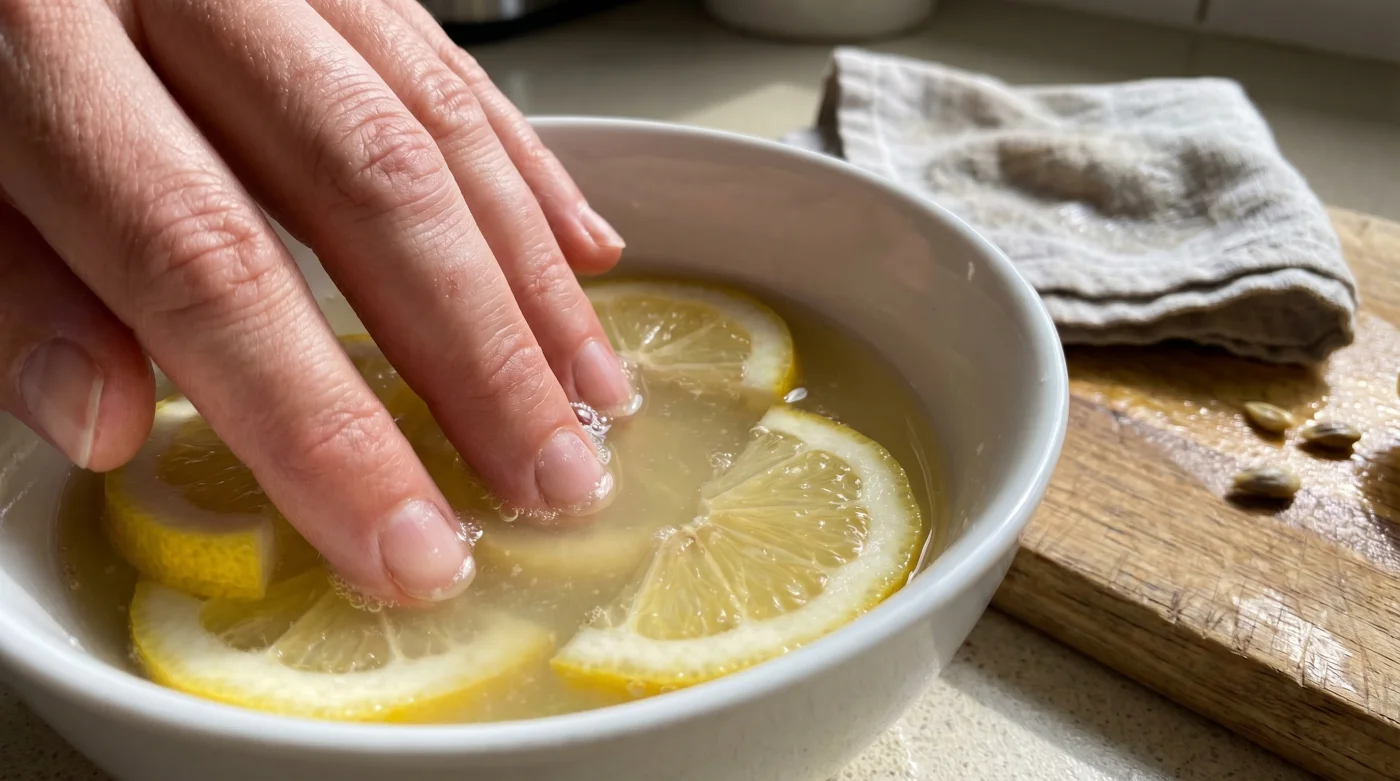
When you submerge your fingertips in a fresh citrus bath, you are not simply bleaching the nail. You are employing a gentle chemical exfoliation process that dissolves the oxidised protein layer where the varnish pigments have taken root.
This perspective shift transforms a mundane kitchen scrap into a highly active, professional-grade tool. By understanding the fruit as an active solvent rather than just a fragrant water additive, you change the way you care for your hands. You stop fighting the stain with abrasion and start gently dissolving it with chemistry.
A London Manicurist’s Secret Weapon
Consider Clara Davies, a forty-eight-year-old editorial nail technician who works on high-end jewellery campaigns across the capital. Her job involves photographing hands at extreme magnification, where every flaw, ridge, and faint discoloration is magnified ten times over. She completely ignores expensive high-street clarifying serums in her heavy kit bag.
Instead, when a model arrives with deeply stained natural nails from weeks of back-to-back fashion shows, Clara asks the catering assistant for a bowl of warm water and a fresh, unwaxed lemon. She creates a bespoke, highly effective soak right there in the dressing room.
- Rub white deodorant stains away with a clean sock
- Swap face towels for a soft old shirt today
- Drop clumpy mascara in hot water for smooth lashes
- Rub cold olive oil on dry hair ends tonight
- Buy Vivienne Westwood pearl necklaces at lower prices today
- Watch Helen Mirren change her silver hair rule today
- Dermatologists reveal the SPF 50 application error that guarantees premature skin sagging.
- The 45-pence pantry staple that dissolves scalp buildup faster than luxury clarifying shampoos.
- The ‘moisturiser sandwich’ trick that allows sensitive skin to tolerate maximum-strength retinol.
- Why hyaluronic acid is accelerating wrinkles in women over 50 (and what to use instead).
“People think you need aggressive buffers to scrape the yellow away,” Clara often tells her junior assistants. “But you just need to let the citric acid eat the oxidised layer. You are just dissolving the stained past, leaving the healthy structure completely intact.”
Tailoring the Citrus Protocol
Not all hands carry the same history, and therefore, the treatment requires slight adjustments depending on how the yellowing occurred in the first place.
For the Serial Varnish Wearer
If your discoloration comes from months of wearing dark reds and navies without a base coat, your nails are likely porous and slightly dehydrated. The citric acid will clean them, but it might strip away what little protective moisture remains.
To counter this, add three drops of sweet almond oil or standard kitchen olive oil to your lemon water. The acid clears the pigment, while the oil replenishes the lipid barrier, leaving the surrounding skin supple.
For the Bare-Handed Gardener
Those who spend their weekends plunging their hands into damp British soil often suffer from deep-set environmental staining rather than cosmetic oxidation. For this, the lemon needs a robust, mechanical scrubbing partner.
Sprinkle a pinch of bicarbonate of soda onto a half-cut lemon and press it directly into the nail plate. This creates an effervescent lifting of ingrained dirt from the microscopic ridges of the keratin.
The Five-Minute Kitchen Spa
To execute this properly, you must abandon the rushed, frantic scrubbing normally associated with removing nail stains. This should be a moment of quiet, mindful restoration.
Here is your tactical toolkit for the perfect clarifying citrus soak. Prepare your space, breathe in the sharp, clean scent of the crushed rind, and allow yourself a brief pause.
- The Water: Exactly body temperature. Too hot, and you will dry out the surrounding cuticle skin; too cold, and the cuticles will tense and close.
- The Ratio: The juice of half a medium-sized, room-temperature lemon to one small cereal bowl of water. Drop the squeezed rind into the bowl—the essential oils in the skin add a layer of natural hydration.
- The Duration: Set a timer for five minutes. Do not watch the clock. Close your eyes and simply let the mild acidity do the heavy lifting.
- The Rinse: Rinse under a lukewarm tap and immediately massage a dense hand cream or raw shea butter into the still-damp nail beds to seal them.
Beyond the Surface
There is a distinct satisfaction in looking down at clean, bare hands. Stripping away the dull, yellowed residue is about more than just preparing for the next coat of colour. It is a quiet acknowledgment of hard work.
When you learn to remedy a physical frustration using only what is sitting in the fruit bowl, you gain a small but profound sense of self-reliance. You realise that sophisticated care requires natural logic, not necessarily a heavy purse.
Your hands interact with the world, tell your stories, and carry your burdens. Giving them five minutes in a warm, citrus-infused bowl is perhaps the most grounding afternoon ritual you can perform.
“True refinement of the hands begins the moment you strip away the camouflage and treat the nail as living tissue, not just a canvas.”
| Key Point | Detail | Added Value for the Reader |
|---|---|---|
| Citric Acid Power | Acts as a gentle AHA to dissolve dead, stained keratin cells. | Saves money on harsh chemical whiteners that damage the nail plate. |
| Lipid Protection | Adding olive or almond oil prevents the acid from drying out cuticles. | Ensures hands remain soft and supple, mimicking a high-end salon treatment. |
| Bicarbonate Boost | Adding baking soda creates a mild, lifting effervescence for deep dirt. | Provides an instant mechanical cleaning solution for gardeners and crafters. |
Frequent Hand-Care Queries
Will neat lemon juice burn my cuticles?
If you have open hangnails or broken skin, neat juice will sting sharply. Always dilute it in warm water unless treating a very specific, localised stain on an otherwise healthy finger.How often can I perform this soak?
Once a fortnight is perfectly sufficient to maintain brightness without over-processing the delicate keratin layers.Does this work for fungal yellowing?
No. Lemon juice is strictly for cosmetic staining (like varnish or nicotine). Fungal infections require professional medical treatments from your local chemist or GP.Should I use bottled juice or a fresh lemon?
Always choose a fresh fruit. Bottled juices are often pasteurised and contain preservatives that diminish the active enzymatic properties of the AHA.What is the best thing to do immediately after?
Massage a thick, emollient cream or cuticle oil into the nails while they are still slightly damp to lock in the ambient hydration.