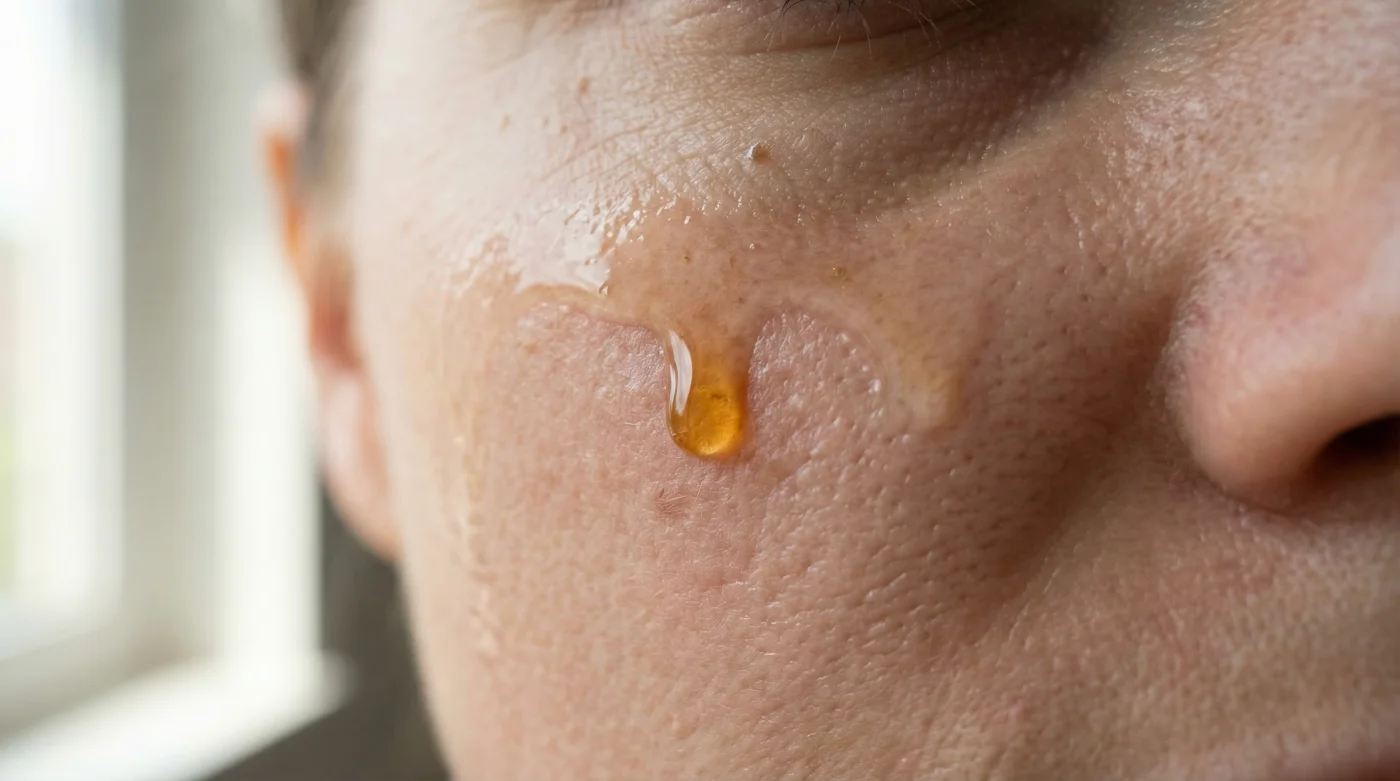
The click of the amber glass dropper. The sharp, slightly metallic tang of citrus in the bathroom air. The chill of the floorboards in early November as the kettle boils somewhere downstairs. You stand before the mirror, ready to apply the golden liquid you bought hoping for a brighter, more even complexion.
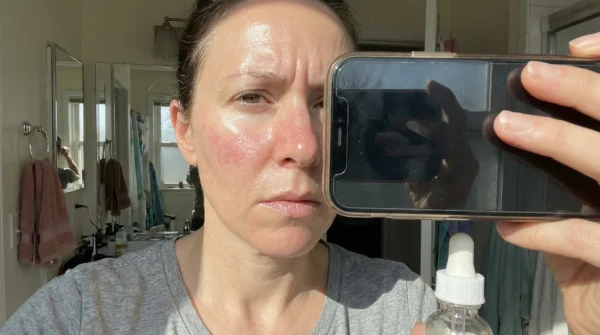
You press the liquid into your freshly washed cheeks, anticipating brilliance. But by lunchtime, you catch your reflection in a shop window and notice a faint, slightly orange tinge gathering around your jawline, or perhaps a tight, prickling heat across your cheekbones that refuses to settle.
The assumption is always that active ingredients demand first access. You are taught to strip away everything, leaving a blank slate, and drop your most volatile, expensive liquids directly onto freshly scrubbed, bone-dry skin.
But naked skin is deeply defensive. When you cross into your forties, that tight, squeaky-clean feeling isn’t a fresh start; it is a disrupted barrier waiting to react. The lipid layer is naturally thinner, and treating it like a resilient sheet of glass is the fastest route to chronic irritation.
The Sponge and the Buffer
Think of a completely dry household sponge left by the kitchen sink. If you pour a thimble of thick, concentrated detergent straight onto the centre, it simply sits there, refusing to soak in or spread evenly across the surface.
Now, imagine running that same sponge under a tepid tap, squeezing out the excess until it is merely damp and pliable. Now the detergent softens into the material instantly, slipping through the porous structure without aggression or pooling.
This is exactly how your face behaves post-cleanse. Hard tap water across most of the UK leaves a chalky, alkaline residue, pulling your face out of its naturally happy, slightly acidic state.
Dropping a highly unstable L-ascorbic acid straight onto this alkaline, dry environment triggers rapid, immediate surface oxidation. That metallic smell and the subtle fake-tan effect on your jawline is simply your expensive serum degrading on contact, burning out before it ever reaches the intended cells.
The Formulator’s Secret
Dr Helena Rostova, a clinical formulator based in a quiet mews in Marylebone, spent a decade watching her private clients over forty struggle with daily redness and diminishing returns from luxury skincare.
“They were punishing their faces,” she noted over a cup of Earl Grey during a morning consultation. “They treated their skin like a sealed envelope. You don’t force a letter in; you gently steam the seal open.”
Her mandate was simple and unshakeable: never apply a volatile active to an unprepared base. An essence or a hydrating mist, applied while the face is still slightly damp from a towel pat, catches the vitamin C, pulling the pH down and stopping the acid from spoiling in the open air.
Adjustment Layers for Your Daily State
Not all buffering bases are created equal, however. The specific liquid you use to prime your face depends entirely on the morning, and exactly how your face feels the moment you wake up.
For the highly sensitive: If your cheeks flush easily after a hot shower, or you deal with mild rosacea flare-ups when the central heating turns on, you need a milky, ceramide-rich fluid.
Think of it as laying down a protective sheet over delicate carpet before bringing muddy boots into the hallway. The ceramides fill the microscopic cracks in a thinning barrier, meaning the serum can do its brightening work without triggering a histamine response.
For the deeply dehydrated: Those with skin that drinks up a thick moisturiser in seconds require a watery, hyaluronic-based essence. The goal here is weightless, immediate hydration that plumps the upper layers.
You must fill the intercellular gaps first, ensuring the active ingredients can glide effortlessly across a hydrated surface rather than sinking into dry, microscopic ravines where they cause stinging.
For the congestion-prone: Even past forty, hormonal shifts can bring sudden, stubborn blemishes around the chin and jawline. A very mild, gently fermented rice water is the perfect intermediary here.
Ferments subtly balance the skin flora, shifting the pH to a slightly acidic state without adding suffocating, heavy weight before your active layer goes on.
For the morning minimalist: If the idea of multiple steps makes you want to abandon the process entirely, a simple hydrating mist will suffice.
A thermal spring water spray requires zero extra minutes and provides a cooling, mineral-rich damp base that prevents your serum from flashing off into thin air.
The Re-Sequenced Morning Ritual
This is not about adding twenty tedious minutes to your morning before the school run or the daily commute. It is about a tactical, deliberate sequence of application.
Move away from the mirror for a moment and focus on the physical sensation. Relying on touch rather than sight prevents over-application. Here is your adjusted, anti-oxidising protocol.
- Cleanse gently with a cream or balm, then pat your face with a clean towel until it is damp, not dripping.
- Dispense three drops of your chosen essence into the palm of your hand and press them firmly into your cheeks, forehead, and neck.
- Wait precisely thirty seconds until the surface feels slightly tacky to the touch, like a post-it note.
- Press two drops of your vitamin C serum over the primed skin, letting it slip over the surface.
The tactical toolkit required for this is minimal but strict. Keep your amber glass bottle in a dark, cool cupboard, ideally away from the steamy bathroom radiator.
The temperature of the liquid matters just as much as the thirty seconds of waiting time. The serum should slip effortlessly under your fingers; if it drags, your base was not damp enough.
Beyond the Bottle
Reframing how you handle your morning routine changes more than just your complexion. It shifts your mindset from treating a problem to cultivating a quiet, supportive environment.
You spend so much energy and hard-earned pounds searching for the miracle cure, expecting instant, aggressive, visible results. But true efficacy always lives in the quiet, mundane preparations.
When you respect the biological boundaries of your face, giving it a cushion before asking it to perform, you remove the daily friction of irritation.
You start your day with an act of gentle, considered facial diplomacy, rather than a chemical shock, setting a calmer tone for the hours ahead.
Your face is not a canvas to be scrubbed and painted; it is a living ecosystem that requires a gentle invitation before accepting change.
| Key Point | Detail | Added Value for the Reader |
|---|---|---|
| The Bare Skin Myth | Applying L-ascorbic acid to bone-dry, alkaline skin post-cleanse. | Prevents the immediate burning sensation and the fake-tan orange staining along the jaw. |
| The Buffer Method | Pressing a hydrating essence onto damp skin before serum. | Lowers the pH gently, allowing expensive active ingredients to actually absorb rather than evaporate. |
| The 30-Second Rule | Waiting until the face feels tacky like a post-it note. | Ensures the base is damp enough to conduct the serum, but not so wet that it dilutes the concentration. |
Frequent Interrogations
Can I just use normal tap water as a buffer?
Unfortunately, most UK tap water is incredibly hard and alkaline. It will actively fight the acidic nature of your vitamin C. Always opt for a formulated essence, mist, or at least a filtered thermal water.Does this mean my current serum is ruined if it smells metallic?
A faint metallic scent is typical of L-ascorbic acid, but if it smells overwhelmingly like old pennies or has turned a dark amber shade in the bottle, it has oxidised and should be discarded.Should I apply moisturiser immediately after the serum?
Give the serum roughly a minute to settle into your buffered skin. Once the face no longer feels wet to the touch, you can seal it in with your moisturiser to lock down the active ingredients.Are all essences acidic enough to work?
Most hydrating toners and essences sit at a slightly acidic pH (around 4.5 to 5.5) specifically to match the skin’s natural mantle, making them highly suitable as a primer for your routine.Will this buffering method dilute the strength of my products?
Quite the opposite. By repairing the delivery system—a damp, receptive sponge—you are actually increasing the effective absorption rate. You will likely find you need fewer drops to achieve a better result.