The morning bathroom is a quiet sanctuary. The mirror is wiped free of steam, the sharp, clean scent of your SPF 50 liquid fills the air, and you massage the white cream into your cheeks until it vanishes into a smooth, invisible finish.
You step out onto the pavement, pulling your coat tight against the damp morning air, feeling entirely protected. A false sense of security wraps around you as you head towards the station, believing that this single morning ritual will hold back the hands of time until the sun finally sets over the high street.
But the truth, hidden beneath the very surface of your skin, is entirely different. By the time you step out of the office to grab a lunchtime sandwich or a quick coffee, that protective barrier has effectively vanished, leaving your face completely exposed to the harsh, cellular damage of midday daylight.
The liquid SPF you carefully applied at seven o’clock is not a permanent, unyielding shield. It behaves like melting butter under the natural warmth of your own complexion, quietly degrading hour by hour and leaving you vulnerable to the exact premature sagging and loss of elasticity you were trying so hard to avoid.
The Architecture of an Expiring Shield
Think of your morning sun cream as a delicate silk umbrella. It catches the first light downpour beautifully, holding the rain at bay while you walk to the shops. But if you leave that silk umbrella open in a persistent, relentless storm, the fabric eventually wets through, rendering it entirely useless. The chemical filters in liquid SPF function precisely the same way; they actively absorb UV energy to protect your cells, but they physically break down in the process.
This is the single most common misunderstanding in modern skin maintenance. Morning application is never enough to carry you safely through the afternoon. By the three-hour mark, the active chemical ingredients have degraded significantly, leaving microscopic gaps in your defence that invite the deep-penetrating UVA rays responsible for degrading collagen and causing gravity to prematurely take hold of your jawline.
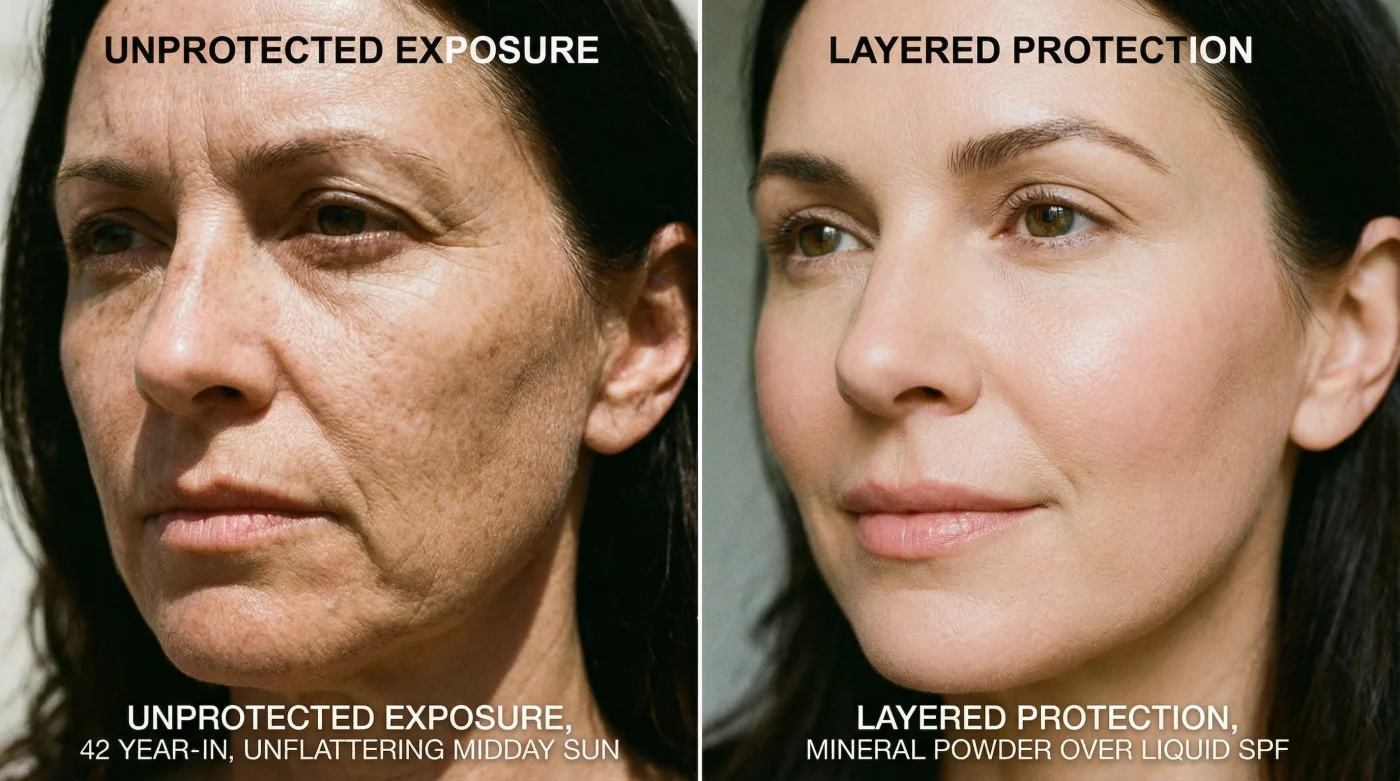
The remedy is not to frantically wash your face in the office toilets at midday and reapply the liquid, a messy and entirely impractical impossibility during a busy workday. Instead, the secret lies in understanding how to anchor that fading liquid with a dry, physical barrier. Layering a dense mineral powder directly over the remnants of your morning SPF creates a physical, light-scattering matrix that immediately halts further UV degradation.
By brushing a physical blocker over the exhausted chemical liquid, you reinforce the collapsing structure, quite literally buying your skin another half-day of structural integrity without disturbing your morning routine or requiring you to start from scratch.
Consider the daily findings of Dr Helena Rostova, a 48-year-old aesthetic researcher operating from a quiet, first-floor clinic in Marylebone. For years, she watched her affluent clients invest hundreds of pounds in the finest liquid sun defences, only to return with the telltale signs of premature jowling and fine lines around the mouth. Helena began gently swabbing their faces at noon, placing the samples under a microscope. She discovered that natural sebum production and the microscopic friction of facial expressions had physically shattered the SPF film by eleven in the morning. Her immediate protocol change—mandating a mid-morning dusting of pure zinc oxide powder over the liquid base—entirely paused the degradation, preserving both the liquid filters underneath and the collagen deep within.
Adjusting the Matrix for Your Day
The beautiful reality of mineral powder is its supreme adaptability. You do not need to adopt a heavy, theatrical makeup routine to achieve this crucial afternoon reinforcement. The approach shifts quite naturally depending on how you spend your waking hours, ensuring that the protection feels like a natural extension of your life rather than a chore.
For the Bare-Faced Purist
If you avoid traditional cosmetics and prefer the raw, breathable texture of clean skin, your best ally is a completely translucent zinc oxide brush. These self-dispensing tools fit effortlessly into a coat pocket and require nothing more than a swift sweep across the forehead, nose, and cheekbones. The pure white powder turns entirely invisible upon contact, absorbing excess noon oil while quietly reflecting the light away from your vulnerable tissue.
For the Desk-Bound Professional
Those spending their days beneath the low hum of office lighting face an entirely different threat: the blue light emitted from screens, which accelerates deep pigmentation just as fiercely as daylight. A tinted iron-oxide pact becomes your vital mid-day ritual here. Pressing a lightly pigmented mineral powder over your face at lunchtime not only tops up your UV defence but physically scatters the damaging blue light reflecting off your monitor.
For the Active Commuter
If your afternoon involves brisk walking, cycling, or chasing after children in the park, you require a mineral layer with far more structural grip. Look for titanium dioxide powders mixed with a hint of natural silica. The silica creates a very slight, breathable mesh over the skin that resists sweat and movement, keeping the UV-reflecting titanium firmly anchored in place even as your body temperature begins to rise.
The Mindful Three-Hour Protocol
Reinforcing your barrier is not a frantic or stressful exercise. It is a quiet, deliberate pause in your day, a brief moment to reconnect with your own physical boundaries. Move with gentle precision, treating the powder not as a cosmetic afterthought, but as vital architectural support for your face.
- Check the time: Aim to apply your powder exactly three to four hours after your morning liquid SPF.
- Blot first: Use a plain, dry tissue to gently press away excess surface oil. Do not rub; simply lay the paper flat against your cheeks and lift.
- Load the brush: Tap your mineral brush against the back of your hand to ensure the powder is resting at the very tips of the bristles.
- Press, do not sweep: Instead of dragging the brush across your face—which disturbs the delicate morning layer—press the bristles directly down into the skin, stippling the powder securely into place.
- Focus on the high planes: Pay special attention to the bridge of the nose, the tops of the cheekbones, and the jawline, where light hits first and degradation happens fastest.
Your Tactical Toolkit:
- Tool: A dense, flat-topped kabuki brush or a self-dispensing mineral brush.
- Material: Pure zinc oxide or titanium dioxide powder (translucent or lightly tinted).
- Time required: 45 seconds of mindful application.
- Frequency: Once at half past eleven, and again at three o’clock if walking home in the afternoon daylight.
Preserving the Canvas of Your Life
When we finally stop treating our morning skincare routine as a magical, impenetrable forcefield, we stop setting ourselves up for inevitable disappointment. Acknowledging that our protective layers break down over time is not a failure of our routine; it is simply the reality of living in a moving, breathing body. Accepting this natural rhythm allows you to care for your skin with much more intention and grace.
Mastering this simple addition—the quiet, mid-day pressing of mineral powder over tired liquid—does far more than just delay the onset of gravity along your jawline. It gives you a profound sense of agency over your environment. You are no longer stepping out into the midday glare crossing your fingers and hoping your early morning effort was somehow enough to see you through.
Instead, you are actively participating in your own preservation. You can sit by a sunny window in a café, walk through the local park at three in the afternoon, or stand waiting for a bus on a busy high street, knowing that your skin’s structural integrity remains entirely intact. The fear of the sun is slowly replaced by a quiet, rhythmic confidence.
The secret to enduring structural youth is not applying stronger chemicals at dawn, but providing a soft, physical roof over those chemicals before noon.
| Key Point | Detail | Added Value for the Reader |
|---|---|---|
| Morning Vulnerability | Liquid SPF filters physically break down and lose efficacy after three hours of wear. | Prevents you from blindly relying on an expired, ineffective morning application. |
| The Powder Matrix | Layering zinc or titanium powder halts the degradation of the underlying liquid filters. | Offers a completely mess-free, instant way to restore full UV protection at work. |
| Application Technique | Pressing or stippling the powder, rather than sweeping it, keeps the base layer intact. | Ensures you do not accidentally wipe away the very protection you are trying to boost. |
Frequently Asked Questions
Does a higher SPF number mean it lasts longer than three hours?
No. A higher number simply indicates a stronger initial block against UVB rays. All chemical filters degrade at roughly the same rate when exposed to heat, sebum, and daylight. You must still reinforce it after three hours.
Can I use a normal cosmetic setting powder instead of a mineral SPF powder?
Standard cosmetic powders entirely lack the dense concentration of zinc or titanium dioxide necessary to physically bounce UV rays away from your face. They will successfully matte the skin, but they will not stop deep cellular sun damage.
Will layering powder make my dry skin look chalky and aged in the afternoon?
If you press the powder gently onto the high points rather than dusting it heavily all over, it will bind beautifully with the natural oils your skin has produced since morning, creating a very natural, skin-like finish.
What if I spend my entire day indoors completely away from windows?
While your direct UV risk is lower, modern office lighting and computer screens emit high-energy visible light that breaks down collagen. A quick dusting of iron-oxide tinted powder helps mitigate this persistent indoor strain.
Do I need to wash my face or use a wipe before applying the midday powder?
Absolutely not. Washing actively removes your foundational liquid layer. The goal is to build upon the remnants of the morning, using the dry powder as a reinforcing roof over the existing structure.