The condensation is still clinging to the bathroom mirror, and the kettle in the kitchen hasn’t quite reached a boil. You twist the cap off your favourite tube, pull out the doe-foot wand, and swipe a crescent of cool liquid under each eye. Instinct kicks in immediately. You reach for a sponge or your ring finger, rushing to sheer out the product before it settles into those faint lines you have noticed creeping in over the last few years.
Panic-blending is entirely natural, especially when we have been taught that makeup must be manipulated while it is wet. We smudge and swipe, watching the coverage sheer out to almost nothing, only to add another layer, compounding the weight and texture. It feels like a losing game against fatigue.
But step into the quiet, brightly lit dressing room of a television studio or a West End theatre, and you will notice a distinct rhythm. The artists do not rush. They apply the product and then they walk away. They make a cup of tea, they brush out the hair, they simply let the face be.
This deliberate pause changes everything about how the product behaves on the skin. You assume wetness equals blendability, but what you are actually doing is wiping away the very camouflage you rely on to look awake.
The Perspective Shift
Think of your morning application less like watercolouring and more like laying down an adhesive. When you drag a sponge over fresh liquid concealer, the water and volatile silicones in the formula have not had a chance to evaporate. You are essentially moving tinted water around your orbital bone.
Letting the formula breathe gently on the skin for precisely three minutes completely alters its structural integrity. As the liquid base evaporates, the suspended pigments bind together, leaving behind a concentrated, tackier consistency. It is the difference between sliding on ice and stepping onto rubber.
By waiting, you aren’t just letting it dry; you are intentionally increasing the pigment density by up to forty percent. A mundane detail like the evaporation of a liquid suddenly becomes your greatest advantage. You suddenly need half the amount of product to achieve double the opacity.
Consider Clara, a session artist working out of a draughty studio in Hackney. For years, she battled the blinding glare of high-definition cameras that mercilessly picked up heavy, cakey under-eyes on her clients. Her breakthrough did not come from a sixty-pound miracle cream, but from a forgotten kettle.
After applying a sheer dot of concealer on a famously sleep-deprived actress, Clara stepped out to make a Yorkshire tea. Returning three minutes later, she went to blend what she thought would be a ruined mess. Instead, the product melted into the skin with mere taps of her fingertip, leaving an impenetrable yet weightless veil over the darkness. The three-minute rule was born out of accidental patience.
Tailoring the Pause
Not all under-eyes are equal, and the way you approach this waiting period depends entirely on your skin’s natural temperament. Adapting the wait time ensures the pigment bonds correctly without dehydrating the delicate orbital skin.
If your skin feels like parchment by midday, a full three minutes might sound terrifying. Your adaptation requires a heavily hydrated base. Pat a lipid-rich eye cream into the skin ten minutes prior, and when you apply the liquid, wait only ninety seconds. The product will tack up, but the lingering oils from your prep will prevent it from turning to cement.
For the oil-prone canvas, you have the ideal texture for the full three-minute wait. Your natural sebum production constantly fights against makeup longevity. By allowing the formula to fully semi-dry, the pigments lock onto the skin, creating a barrier that your natural oils struggle to dissolve.
When mature skin loses elasticity, heavy layers pool into crevices. Your goal is maximum opacity with minimal weight. Use a microscopic dot of product—far less than you think you need—and commit to the three minutes. Because the pigment density increases by forty percent, that tiny speck will offer the coverage of a thick smear without the bulk.
The Mindful Application Method
Mastering this requires deliberate compression, shifting from frantic swiping to a quieter, softer approach. It is about understanding the physics of your products and treating the application with a touch of restraint.
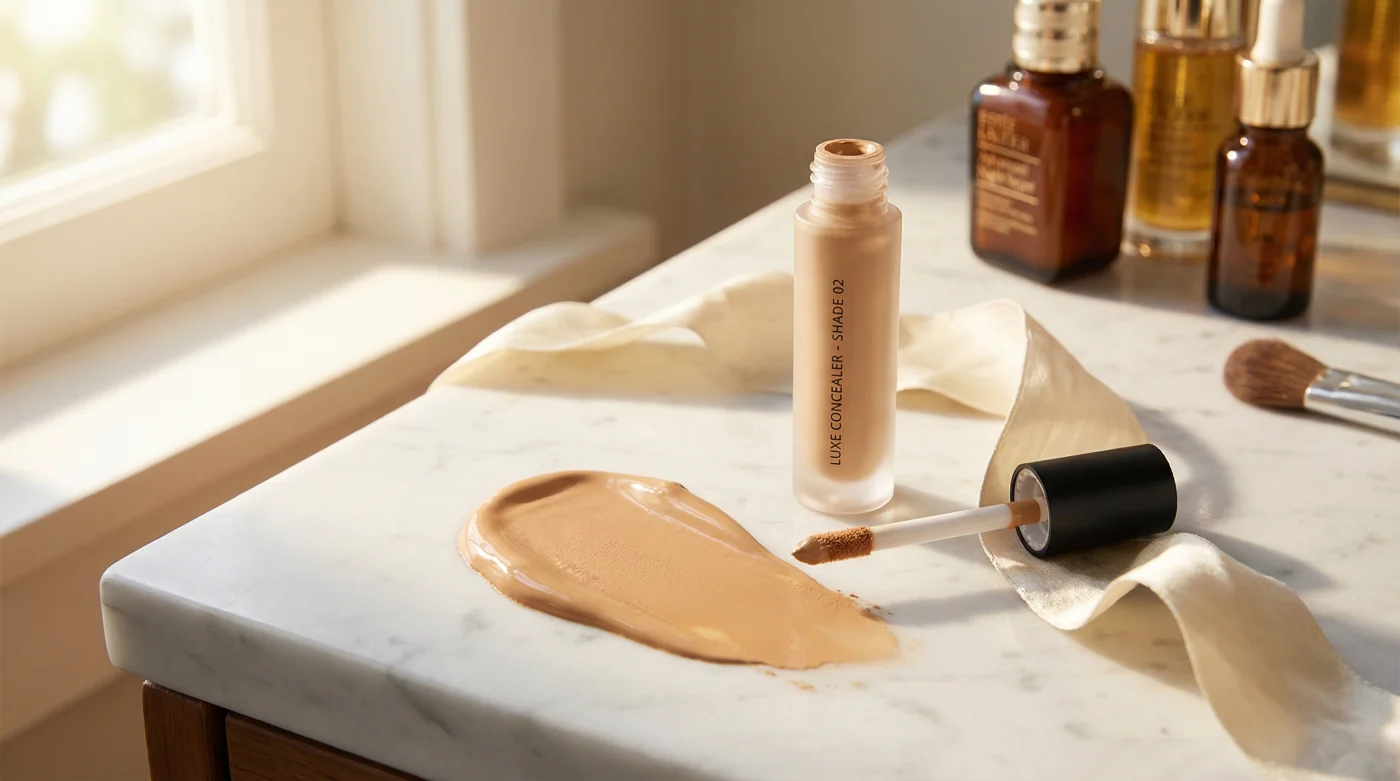
Your tactical toolkit is minimal. Gather a lightweight, self-setting liquid concealer, a damp bouncy makeup sponge squeezed out in a towel until nearly dry, your ring finger, and a reliable timer like your phone or a kitchen clock.
The sequence is incredibly straightforward, provided you respect the clock and refuse the urge to fiddle with the product prematurely.
- Cleanse and moisturise as normal, giving your skincare a few minutes to sink in.
- Dot the concealer exclusively on the darkest areas, usually the inner hollow beside the bridge of the nose.
- Step away and do not touch the area for exactly three minutes.
- Take your damp sponge or ring finger and press straight down into the semi-dried product like stamping a seal.
- Feather only the outermost edges to marry the high-density pigment into your bare skin.
There is a profound psychological benefit to adopting a technique that actively forces you to stop. We treat our mornings as a sprint, a frantic accumulation of tasks designed to get us out the door looking presentable.
Choosing to wait three minutes interrupts that frantic momentum, turning a rushed chore into a moment of deliberate stillness. You aren’t just waiting for makeup to dry; you are giving yourself permission to pause before demanding things to perform.
When you finally look in the mirror, the darkness is gone, replaced by a smooth, unbothered brightness. The under-eye is flawless not because you fought it into submission, but because you gave it the time it needed to work on its own terms.
“Patience is the only invisible ingredient that makes everything else in your makeup bag work twice as hard.” — Clara, Session Makeup Artist
| Key Point | Detail | Added Value for the Reader |
|---|---|---|
| Pigment Density | Evaporation increases opacity by 40%. | Use half the product for double the coverage. |
| Application Tool | A nearly-dry damp sponge or ring finger. | Prevents lifting the tackified product off the skin. |
| Skin Adaptation | Reduce wait to 90 seconds for dry skin. | Prevents creasing while still gaining coverage benefits. |
Frequently Asked Questions
Will waiting three minutes cause my concealer to crease more?
No. Creasing is caused by excess product and moisture pooling in fine lines. Because this method evaporates the moisture and requires far less product, creasing is significantly reduced.Does this work with cream concealers in a pot?
This specific technique relies on the evaporation of water and volatile silicones found in liquid formulas. Pot concealers are wax and oil-based, meaning they will not tack up in the same way.What if my concealer dries down completely before three minutes?
If you are using an ultra-matte, fast-drying formula, adjust your wait time to sixty seconds. The goal is a semi-dry, tacky finish, not a fully set crust.Should I still set my under-eyes with powder?
Because the liquid base has already evaporated, you will need very little powder, if any at all. A light dusting solely on the outermost edges is usually sufficient.Can I use a brush instead of a sponge or finger?
Brushes tend to leave streaks when working with semi-dry, tacky products. A pressing motion with a sponge or finger is necessary to stamp the pigment seamlessly into the skin.